
Steve Patterson recalled UCLA basketball practices as “. . . sharp cuts, the sounds of sneakers squeaking on the wood floor, the ball popping. Coach Wooden’s voice echoing in the Pavilion, the feeling of harmony — it was as close to perfection as you can imagine” (Camille Bersamin, Sports Illustrated).
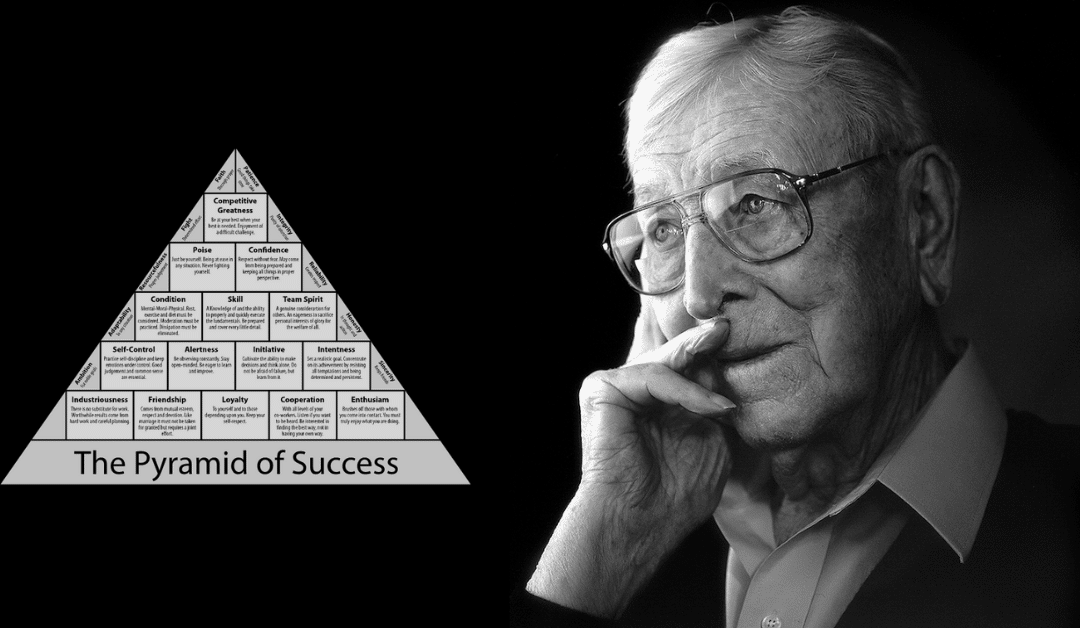
We continually encounter UCLA basketball players, coaches, and observers who were smitten by those practices. Later generations have benefited from articles, books, and academic literature, but Coach Wooden’s Pyramid of Success crystalizes so much of that philosophy. That is why discussions of the Pyramid are a recurring theme at CrewLAB.
I would like to reflect on the middle layer: Conditioning-Skill-Team Spirit.
Conditioning: This block is the sweet spot for rowers. We live for erg training and cross training. We vary our training with steady state work and sprints. Advances in technology have enabled this obsession. Heart Rate Monitors were the “gateway drug” for advanced training metrics, which led to debates on the proper amount of training time in various heart-rate zones. More sophisticated coaches monitored lactic acid levels. (In an upcoming blog, CrewLAB’s Simon Hoadley will share how he was able to incorporate lactic acid monitoring into a collegiate, club rowing program.) Many of us are awaiting the maturation of Continual Lactate Monitoring (CLM) devices. Wearables and bio hacks deserve their own category of monitoring, but within the context of the John Wooden Pyramid, they are tools for conditioning.
Skill and Team Spirit complete the middle layer of the Pyramid: Coaches and rowers of team boats should understand Skill and team Spirit as one block. In this regard, the work of Brian Klaas provides insight. He is a Professor of Global Politics at Oxford University. He writes widely and is widely cited. His recent book is Fluke: Chance, Chaos, and Why Everything We Do Matters (2024).
It stands to reason that a book on the nature of the universe would include rowing. It does. Specifically, Klaas provides the academic reason why rowing coaches are never-satisfied taskmasters. Quick Digression: Not being satisfied is not a free pass for mean spirited or demeaning behavior. It does not mean being profane. (“Goodness gracious” was Coach Wooden’s equivalent of an f-bomb.) Nevertheless, a continual dissatisfaction, a continual pursuit of further polish is inherent in rowing.
Why?
Klass differentiates between strong-link and weak-link problems. He defines basketball as a strong-link scenario where “you can ignore the bad stuff and focus on making the best stuff better” (210). Michael Jordan was a transformational athlete, but it was not essential that his “supporting cast” operate at his level.
This is not the case with rowing. “Rowing is the exact opposite. Speed is a function of synchronization, balance, and timing. In a crew of eight rowers and one coxswain, if even one rower is a bit off, the boat will lurch side to side, the oars slapping the water and creating drag. The crew will lose. They’re only as good as their worst athlete. That makes it a weak-link problem” (210). Thus, Team Spirit and Skill are inseparable. The skill of the boat is the teamwork of the boat. The boat needs continual, repetitive, endless practice. The coach can never be satisfied. Nor can the crew. In our information age, every newsletter and every coach dispenses advice, but advice is not the answer. The answer is repetition until every part of the boat gets it right. Klaas’s refrain is “Everything matters.”
In this regard, John Wooden had the mindset of a rowing coach, and his non-stop pursuit of practice perfection is why he was not only a great basketball coach, he was iconic and legendary. He was the Wizard of Westwood. HIs success with dominating big men (Kareem Abdul-Jabbar and Bill Walton) was a tribute to his adaptability. His preference was for team play and the relentless elimination of weak links.
Klass also discusses the culture of wearables, bio hacks, and the technology of conditioning. According to the author, “Everything, even joy, can be turned into a metric. Did you really go on that walk in the wilderness if your Fitbit didn’t register your step count?” (253). He warns against “obsessive optimizers, worshipping the false god of ever more efficiency, modern social systems have little slack” (102).
Reading these passages after a bad workout can tempt one to become a recreational sculler; to abandon tests, grades, and finish lines. We might go there except for one thing: Team Spirit.
“. . . if we want to maximize the chance that our actions will matter even more, then the best pathway comes from one of the finest innovations our species has evolved: cooperation. Humans who work together create change together” (255).
By the way, I should share — if you have not already suspected as much — that Brian Klaas rowed for four years while pursuing his studies at Oxford.
Professor Klass, rowers, and students of Coach Wooden know it is all about working together. The blocks of the Pyramid build upon and reinforce one another. Conditioning helps Skill. Team Spirit helps Skill and rescues Conditioning from hyper-optimization. Team Spirit is more than well-intentioned phrases and mottoes. It recognizes the role of friction, disagreement, and failed execution, but as we reflect on our past successes, we notice that success — that “peace of mind which is a direct result of self-satisfaction in knowing you made the effort to become the best of which you are capable” — involves working with teammates and colleagues. That is why Conditioning-Skill-Team Spirit is the linchpin of the John Wooden Pyramid of Success.