
What John Wooden teaches us about team culture
We have previously written about John Wooden. His record of 10 NCAA championships gets our attention, deservedly so, but the real story is his attention to detail and teamwork. The anecdotes about his teaching players the proper way to put on their socks were not an idiosyncratic affectation. It was coaching from the ground up. Everything, every day contributed to success.
I was privileged to enjoy many morning coffees with the great golf coach Eddie Merrins whose accomplishments as a player, coach, and teacher are legendary. He told me how when he was coaching the UCLA Men’s Golf Team, he asked John Wooden to come and talk to about winning. Coach Wooden agreed and spoke for 90 minutes without ever talking about winning. It wasn’t necessary. When you took care of the details, the winning took care of itself.
John Wooden was often called the “wizard.” (See Dwight Chapin and Jeff Prugh’s early biography: The Wizard of Westwood: Coach John Wooden and His UCLA Bruins). Of course, the secret of Wooden’s wizardry was that there was no wizardry. The success of his teams was based on daily practice, practices that were works of art. These were practices that players remembered after the playing days. Steve Patterson recalled practices that “were choreographed like a ballet . . . The sharp cuts, the sounds of sneakers squeaking on the wood floor, the ball popping. Coach Wooden’s voice echoing in the Pavilion, the feeling of harmony — it was as close to perfection as you can imagine” (Camille Bersamin, Sports Illustrated).
Steve Patterson is a sports trivia answer: During Coach Wooden’s reign of unrivaled dominance, who was the UCLA center who came after Lew Alcindor (Kareem Abdul-Jabbar) and before Bill Walton?
The 10 NCAA championships offer a longitudinal study of performance culture. UCLA’s first NCAA basketball championship was the 1963-1964 team. This team was a small team: Gail Goodrich (6’1″) and Walt Hazzard (6’2″). With a small team, Wooden won. After Wooden won with a small team, he won with the dominating big-man, Jabbar (7’1″). When Jabbar left, Wooden still won, this time with Steve Patterson (6’9″) at center. After Patterson, Wooden won with the colorful and powerful Bill Walton (6’11”). In other words, the accomplishments were not dependent on a dominating player, nor on a particular kind of player.
On those teams there was a culture of accountability and discipline. Scott Howard-Cooper (Kingdom on Fire: Kareem, Wooden, Walton) recounts how the players were instructed to leave their hotel rooms immaculate. When they left a visiting locker room, every towel was folded. Restaurant wait staff would comment on the politeness of the players. These were the details of accountability.
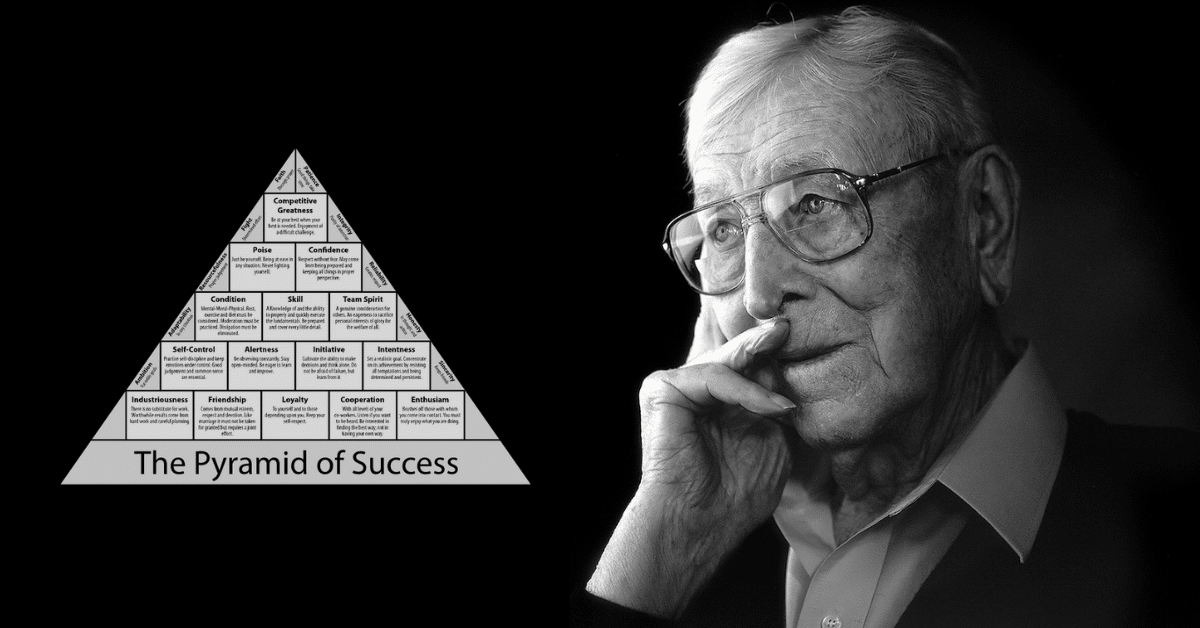
The details created the culture, and the culture created the foundation. It is no coincidence that John Wooden’s approach was known as the Pyramid of Success because a pyramid is built upon on a strong foundation. In Wooden’s pyramid, the ground layer comprises Industriousness, Friendship, Loyalty, Cooperation, and Enthusiasm.
The team succeeds because of buy-in and building. As an example, think of the CrewLAB wellness check-in. It is not a casual affirmation, something to click through. Rather, the athlete acknowledges the importance of a daily self-assessment. The other athletes do the same. Together, they work hard, cooperate, and enthusiastically build friendships, which leads to the next layer: Self-Control, Alertness, Initiative, and Intentness. Coach Wooden continually instructed, “Make each day your masterpiece.” The mindset occurs “each day,” which is particularly important for endurance athletes because daily practice is the daily bread of improvement.
The CrewLAB training calendar lays out the schedule, the focus, and intensity. Maybe today is V02 max day. Tomorrow might be a lighter cardio load, but the emphasis will be on technique. Either way the athlete knows that “each day” something occurs to bring about improvement. Everyone is working on the details of performance, which seamlessly exemplifies the third layer of the pyramid: Conditioning, Skill, Team Spirit.
The upper level of the pyramid is Poise and Confidence, which just happens — no wizardry involved — when we work on the details.
And when one arrives at the apex, Competitive Greatness, it is redundant. It is a recapitulation of everything that has already taken place.
The Pyramid of Success is like John Wooden’s talk to the UCLA golfer. No need to use the word “winning.” But we experience success, that “peace of mind which is a direct result of self-satisfaction in knowing you made the effort to become the best of which you are capable.”
Apply John Wooden’s Pyramid of Success framework with the help of CrewLAB. Sign up today.